Hierarchy of autonomous operations with agentic workflows
AI agents and agentic workflows are progressing from being in the experimentation stage to being implemented into enterprise operations at scale. Enterprises are starting to experiment with whether AI systems can help route workflows, recommend next actions, escalate exceptions, extract data, generate scripts, and support operational decisions inside live workflows.
The impetus is architectural. An agentic workflow isn't just an AI model connected to APIs—it's a workflow that must observe state, make bounded decisions, execute approved actions, track outcomes, preserve audit history, and escalate when confidence or policy requires human review.
This reframes the thought process from "which AI model to use" as a vague qualifier to "what workflow infrastructure can safely/intuitively support partial autonomy without oversight?"
What agentic workflows actually are
An agentic workflow is one in which an AI system can make decisions or trigger actions within predefined limits.
It's not:
- A chatbot that answers questions
- A simple automation rule that follows fixed if-then logic
- A generative AI feature that creates text, images, or code in isolation
It's closer to an operational decision layer inside a workflow. The AI observes workflow data, interprets context, recommends or selects the next action, and hands execution back to the workflow runtime.
In practice, this might look like:
- An incident response workflow where AI analyzes an alert, suggests remediation, and routes the request to the right engineer
- A user onboarding workflow where AI reads documents, extracts required employee details, and suggests missing fields before provisioning starts
- A procurement workflow where AI classifies a request, identifies policy exceptions, and routes it for the correct approval path
- A service request workflow where AI drafts a response, recommends the next transition, and escalates when SLA risk is detected
The important distinction here is control. The AI shouldn't become the monopolizer for handling operations with unrestricted free access—it should operate within set workflow boundaries, including approved actions, role permissions, SLA rules, transition conditions, fallback paths, and audit requirements.
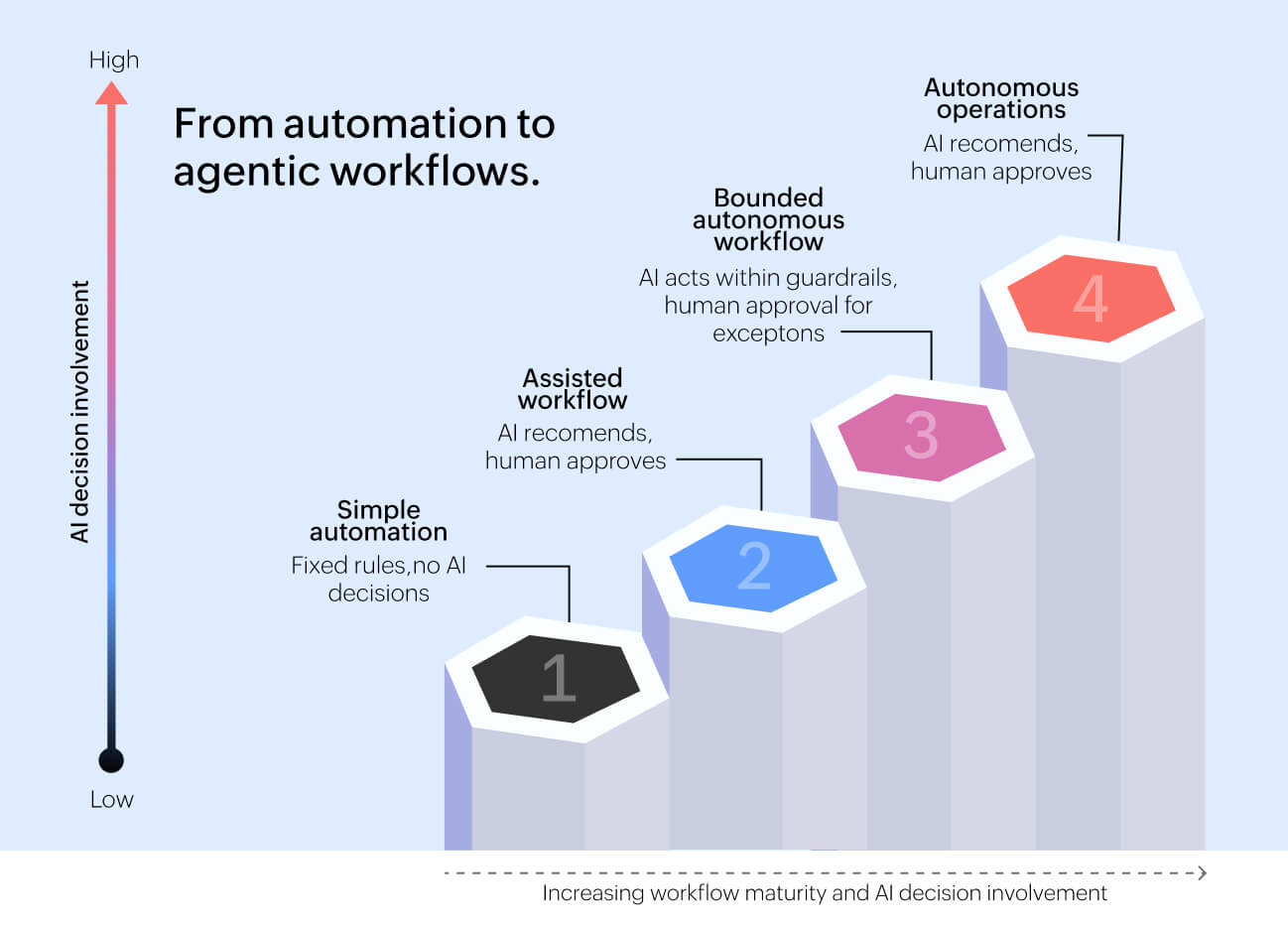
For most enterprises, the near-term model isn't "full autonomy"—it's assisted and bounded autonomy, where AI helps the workflow move faster while the orchestration layer enforces governance.
Why agentic workflows need orchestration platforms
Agentic workflows are fundamentally orchestration problems.
The pattern is familiar:
- A trigger starts the workflow.
- Data is collected from forms, files, systems, or messages.
- A decision is made.
- Work moves across systems, teams, or approval stages.
- Actions are executed.
- Exceptions are handled.
- The workflow state is tracked.
- The outcome is audited.
AI fundamentally changes who helps make some decisions, but it doesn't curb operations that rely on orchestrations. It enhances them.
A standalone AI layer may generate recommendations or code, but enterprise operations need more than suggestive LLM inputs. They need execution control, permissions, state, recovery, compliance, visibility, and tracebility.
A workflow orchestration layer provides the operational foundation that agents need:
- Execution runtime: The workflow runtime decides when actions run, in what order, and under what conditions.
- System connectivity: Actions can trigger webhooks, custom functions, scripts, and notifications, as well as integrations with internal or external systems.
- State management: Work moves through defined stages and transitions rather than being hidden in ad hoc scripts.
- Governance: Role-based access, approval paths, SLA rules, and escalation behavior define what can happen.
- Auditability: User actions and automated events must be traceable for review, debugging, and compliance.
- Observability: Teams need to know what the workflow did, what failed, what was retried, and where intervention is needed.
- Error handling: Retry, fallback, timeout handling, and manual escalation are essential when AI-assisted actions touch real operations.
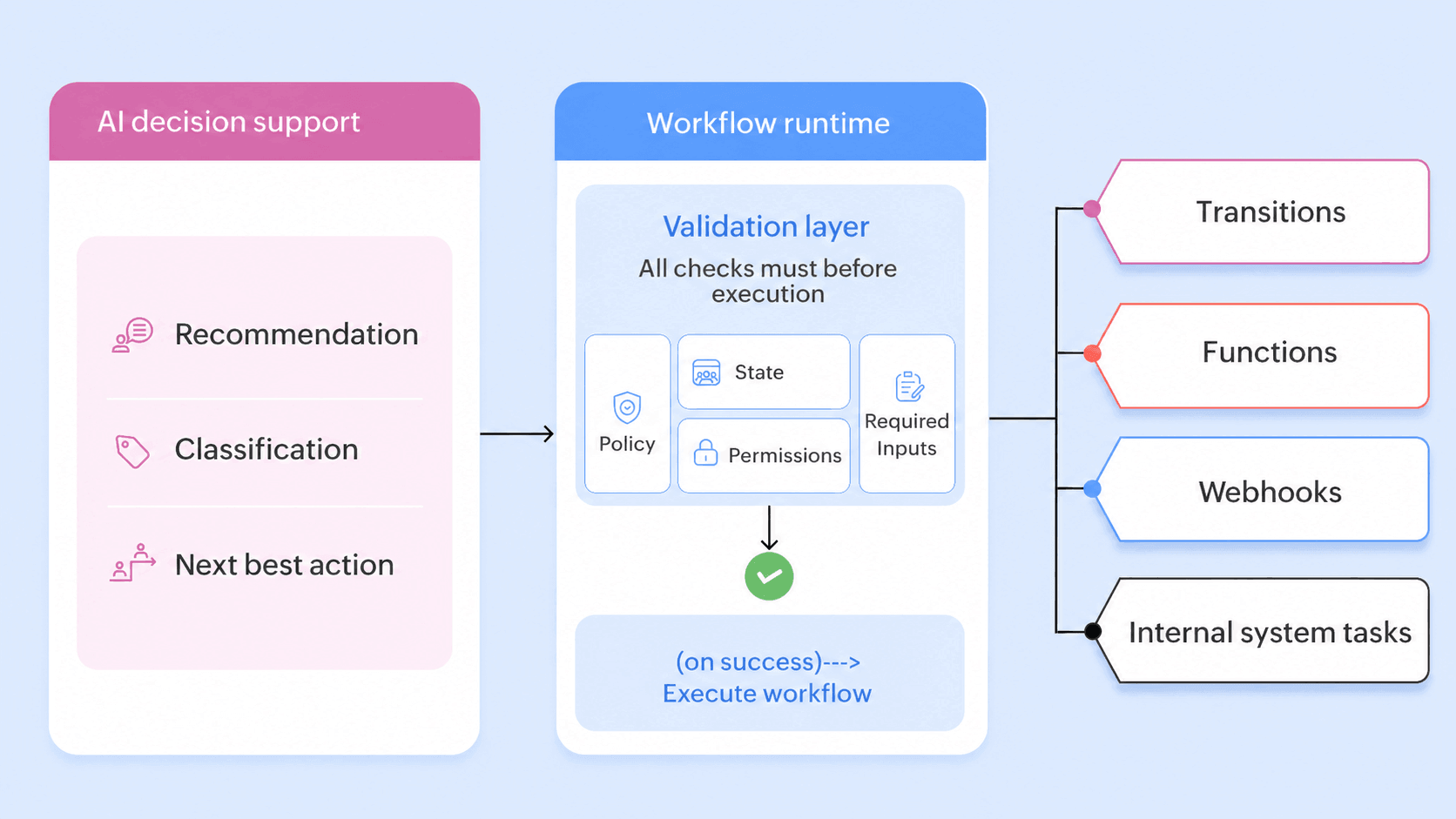
It's best to avoid letting agents call enterprise systems directly without a workflow control layer in these situations. A safer pattern is “agent recommends, workflow executes.” The AI can propose a transition, remediation, classification, or script, but the workflow runtime should validate permissions, data, state, and policy before execution.
The agentic workflow maturity path
Enterprises don't need to jump directly into autonomous operations. A practical maturity path lets teams build confidence while reducing risk.
Assisted workflows
In this stage, the human remains the decision-maker. AI supports the workflow by suggesting fields, generating scripts, extracting data from files, drafting responses, translating content, or recommending next actions.
Example: In an incident workflow, AI summarizes the alert and suggests a remediation step. An engineer reviews and approves the transition.
This is the right starting point because it improves productivity without giving AI direct operational control.
Bounded autonomous workflows
In this stage, AI can take limited actions inside explicit boundaries. The workflow defines what the AI can influence, what requires approval, and when fallback or escalation is mandatory.
Example: A request is classified automatically. Low-risk requests move to the next stage, while high-risk requests route to a human approver.
This stage requires clear guardrails:
- Which actions can be automated
- Which fields can be modified
- Which transitions can be triggered
- Which systems can be touched
- Which confidence level requires review
- Which exceptions must escalate
Adaptive workflows
In this stage, the workflow starts using historical outcomes to improve routing, prioritization, recommendations, or exception handling. The risk increases because decisions may change over time.
Example: A support workflow learns which categories are most likely to breach SLAs and recommends earlier escalation.
Adaptive behavior must be explainable enough for operations teams. If the system changes routing behavior, teams need to know what signal influenced the decision and how to override it.
Autonomous operations
This is the long-term model, where complex workflows run mostly without human intervention. Humans still supervise exceptions, policies, and high-impact decisions.
Example: An order-to-delivery process coordinates validation, inventory, payment, fulfillment, notification, exception handling, and auditing with minimal manual input.
For most enterprises, the realistic goal today is to build infrastructure for assisted and bounded autonomy. That means making workflows stateful, observable, auditable, and governable before increasing AI control.
Infrastructure requirements for agentic workflows
AI inside the workflow context
AI should work with workflow data, not outside it. The useful pattern is AI embedded into workflow design, scripting, parsing, classification, and decision support.
For example, AI can help generate workflow scripts, extract structured fields from uploaded files, or support multilingual workflow interactions. These are practical foundations for more advanced agentic behavior, because they keep AI close to governed workflow execution.
Any AI-generated script should be reviewed, tested, and validated before production use. Treat AI-assisted code as a draft, not as approved code.
Fine-grained execution control
Agentic workflows need controlled execution. The AI may recommend an action, but the platform should execute it through configured workflow states, transitions, functions, webhooks, or bridge-based tasks.
That matters because operational workflows often touch sensitive systems. A provisioning action, payment exception, database update, or service restart shouldn't depend only on a model response.
The workflow should control:
- Who or what can trigger the action
- Which stage the workflow must be in
- Which inputs are required
- Which conditions must be true
- What happens on timeout, authorization failure, or execution failure
- Whether retry or fallback is allowed
Decision and execution audit trails
Agentic workflows need two types of visibility: decision visibility and execution visibility.
Decision visibility answers:
- What did the AI recommend?
- What data influenced the recommendation?
- Was the recommendation accepted, rejected, or overridden?
- Who approved the final action?
Execution visibility answers:
- Which state ran?
- What input was used?
- What output was returned?
- Did the execution fail?
- Was it retried?
- Which fallback path was used?
Sensitive data in prompts, payloads, files, logs, and outputs must be masked, redacted, encrypted, or hidden where appropriate. Don't expose personal data, credentials, tokens, customer records, or regulated fields to users who don't need them.
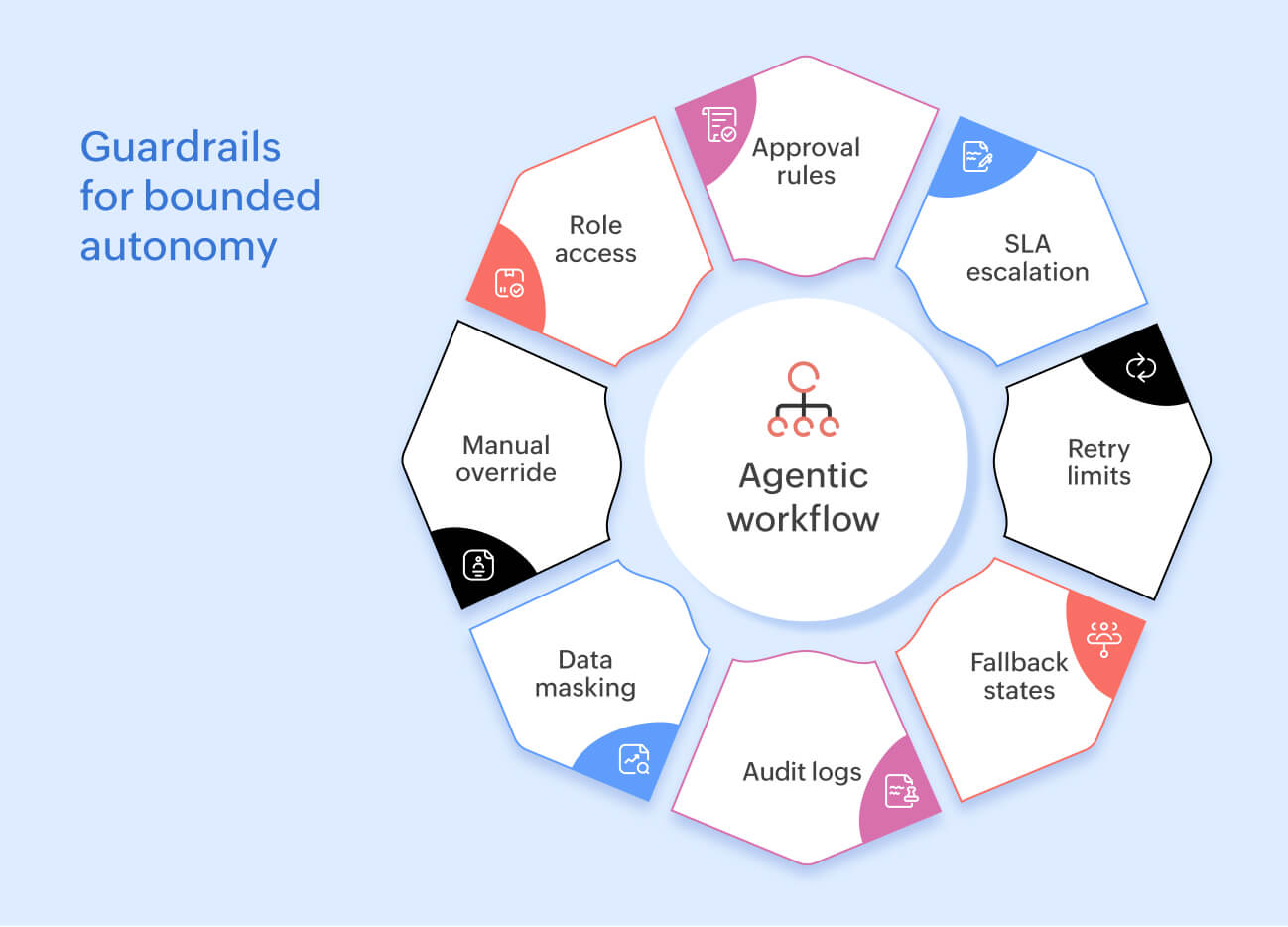
Governance and guardrails
Agentic workflows should be designed with narrow permissions first. Start with recommendation-only use cases, then allow low-risk automated transitions, then expand toward bounded execution.
Guardrails to implement:
- Role-based access
- Approved transition paths
- Mandatory human approval for high-impact actions
- SLA-based escalation
- Retry limits
- Fallback states
- Data validation before execution
- Manual override options
- Stop controls for stuck or long-running executions
Observability for agentic decisions
Traditional workflow observability shows status, stage, duration, errors, and logs. Agentic observability must also show why an AI-assisted decision happened.
Teams should be able to investigate:
- Why the workflow was routed to a specific stage
- Why the AI recommended escalation
- Why a fallback path was used
- Whether the decision matched policy
- Whether a human approved or overrode the recommendation
Without this, AI becomes another black box inside enterprise operations.
How to build agentic workflow readiness without overbuilding
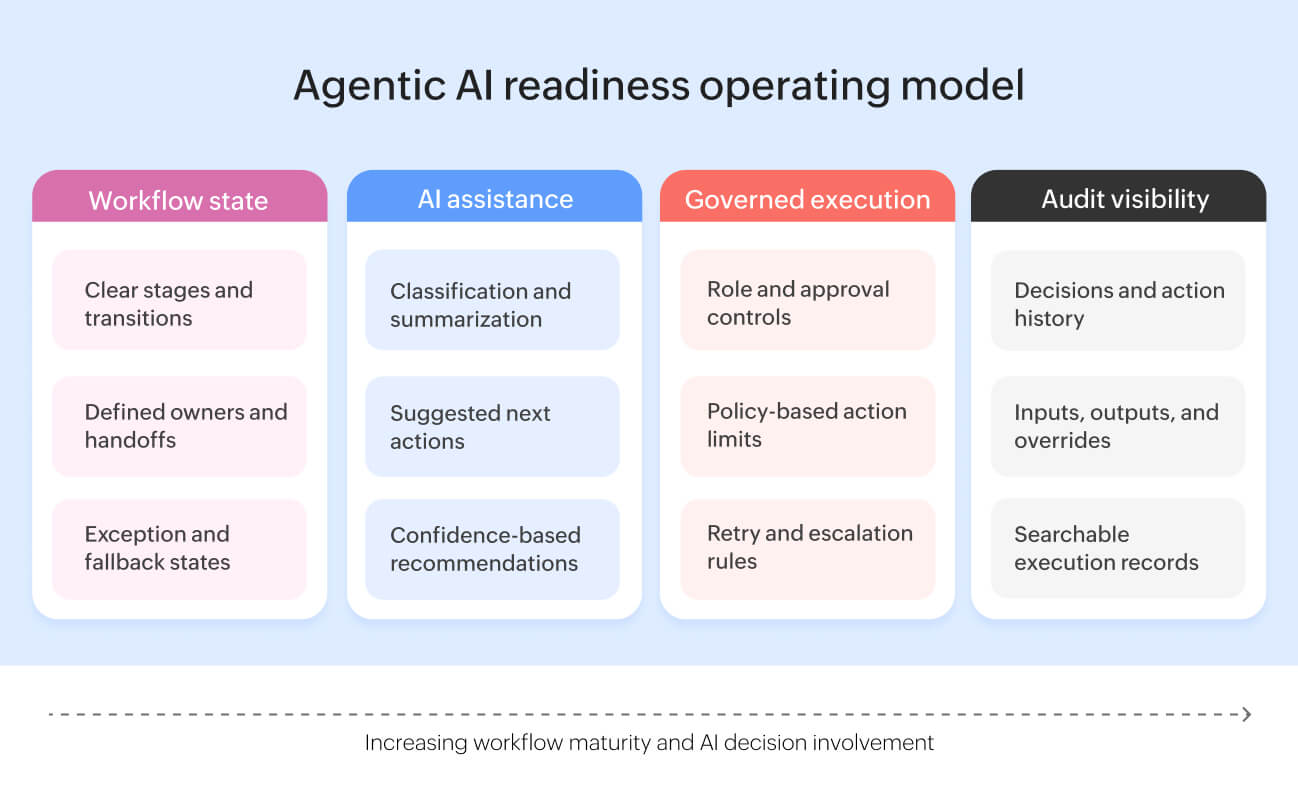
The best preparation isn't to launch autonomous agents everywhere. It's to make existing workflows ready for bounded intelligence.
Start by converting ambiguous process steps into explicit workflow states. If a process currently depends on informal judgment, hidden spreadsheets, email threads, or manual follow-ups, it's not ready for agentic execution. The workflow must expose stage, owner, inputs, decisions, outcomes, and exceptions.
Next, separate the recommendation from the execution. Let AI assist with classification, data extraction, summarization, script generation, and next-step suggestions. Keep production execution in line with workflow rules, permissions, and approvals.
Then design the exception model. Every agentic workflow needs a clear answer to: What happens when confidence is low? What happens when data is missing? What happens when the action fails? What happens when the AI recommendation conflicts with policy?
Finally, measure readiness through operational evidence, not AI ambition. A workflow is ready for bounded autonomy when it already has clean state tracking, reliable execution logs, tested error handling, clear ownership, strong audit history, and well-defined escalation behavior.
How autonomy and AI agents go hand-in-hand
Agentic workflows aren't a separate category of enterprise software—they're an evolution of workflow orchestration.
AI can recommend, classify, extract, summarize, generate, and eventually act within bounded rules. But the enterprise value depends on the orchestration layer around it: state, permissions, execution control, retries, fallback, SLA tracking, audit history, and observability.
The safest path is incremental. Build assisted workflows first. Move to bounded autonomy where risk is low and governance is strong. Keep humans in control of high-impact decisions until the workflow architecture is mature enough to support more autonomy.
The enterprises that prepare now won't just adopt AI agents faster—they'll adopt them with less operational risk.

Enjoying your reading?
Enjoy organization and visibility too!
Qntrl can help you organise, control and improve production and projects in your team.