The evolution of process-oriented middleware in complex enterprise environments
Broken workflows, fragile integrations, data duplication, and dependence on manual processes are recurring challenges in enterprise environments that operate with ERPs, cloud platforms, legacy systems, and distributed applications. Companies need to coordinate executions, apply business rules, control approvals, ensure traceability, and monitor critical processes in real time.
It's in this context that process-oriented middleware emerges: an evolution of traditional integration that ensures governance, orchestration, and operational visibility.
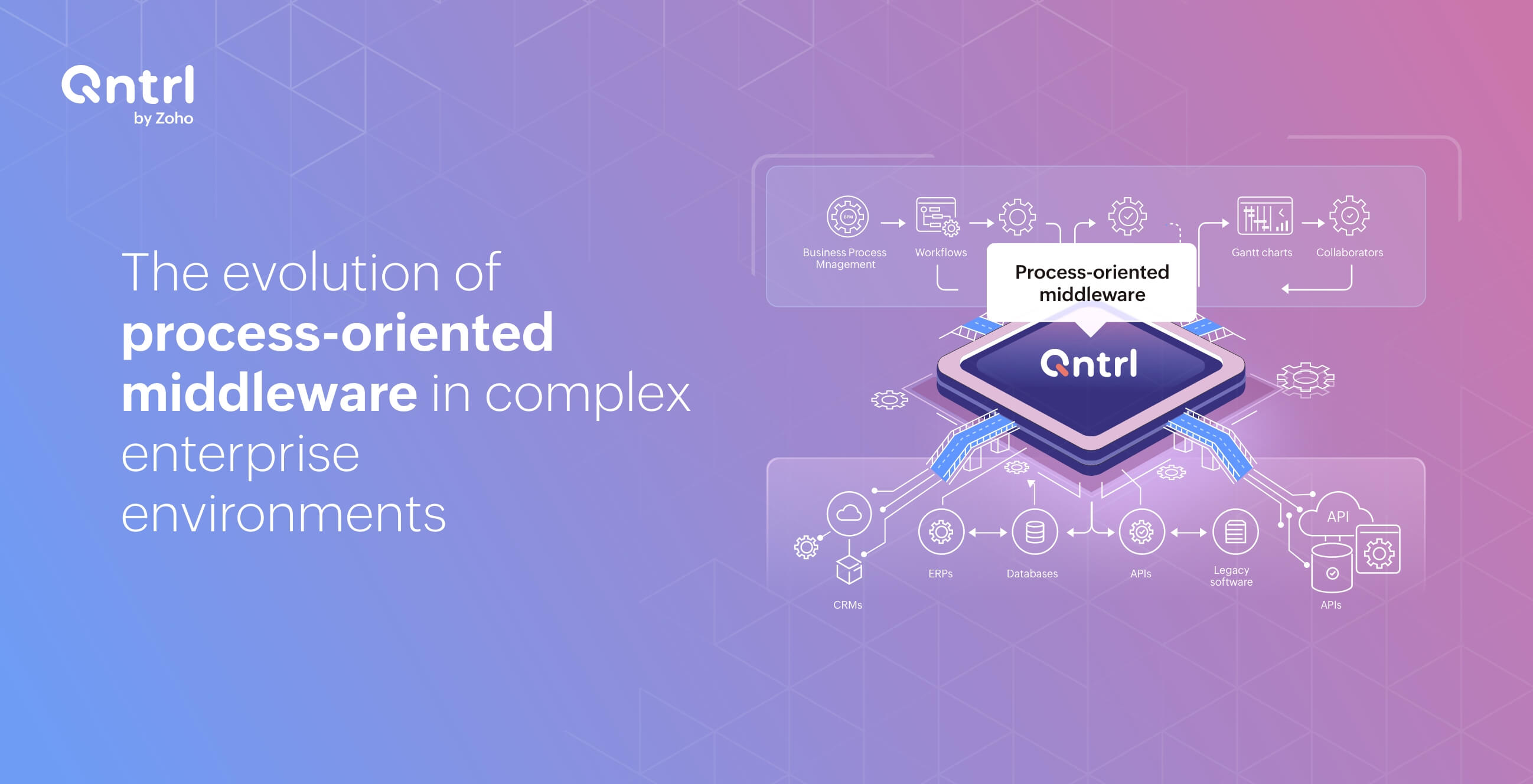
Qntrl adopts this approach by acting as a central coordination layer between systems, processes, and teams. More than integrating applications, the platform organizes workflows, automates executions, applies corporate policies, and provides end-to-end visibility over critical operations.
The evolution of integration
Initially, middleware was designed to transform and transport data between different applications, regardless of where those systems were hosted: on-premises, in private data centers, or in the cloud. Its role was to ensure that information left one point and correctly reached another.
This model worked for years for relatively simple integrations. However, in modern enterprise environments, made up of multiple ERPs, SaaS platforms, APIs, legacy systems, and distributed applications, simply moving data between systems no longer meets the operational needs of companies.
In large organizations, corporate processes depend on business rules, approvals, validations, security policies, SLAs, and conditional workflows that need to be executed in a coordinated and traceable way.
Without a central orchestration layer, these rules end up distributed across applications, custom scripts, and point-to-point integrations, increasing operational complexity, dependence on specific technical knowledge, and the risks of inconsistency.
Process-oriented middleware emerges exactly as a response to this scenario. Instead of acting only as a data bridge, it coordinates how work happens between systems, users, and corporate operations.
Traditional middleware vs. process-oriented middleware
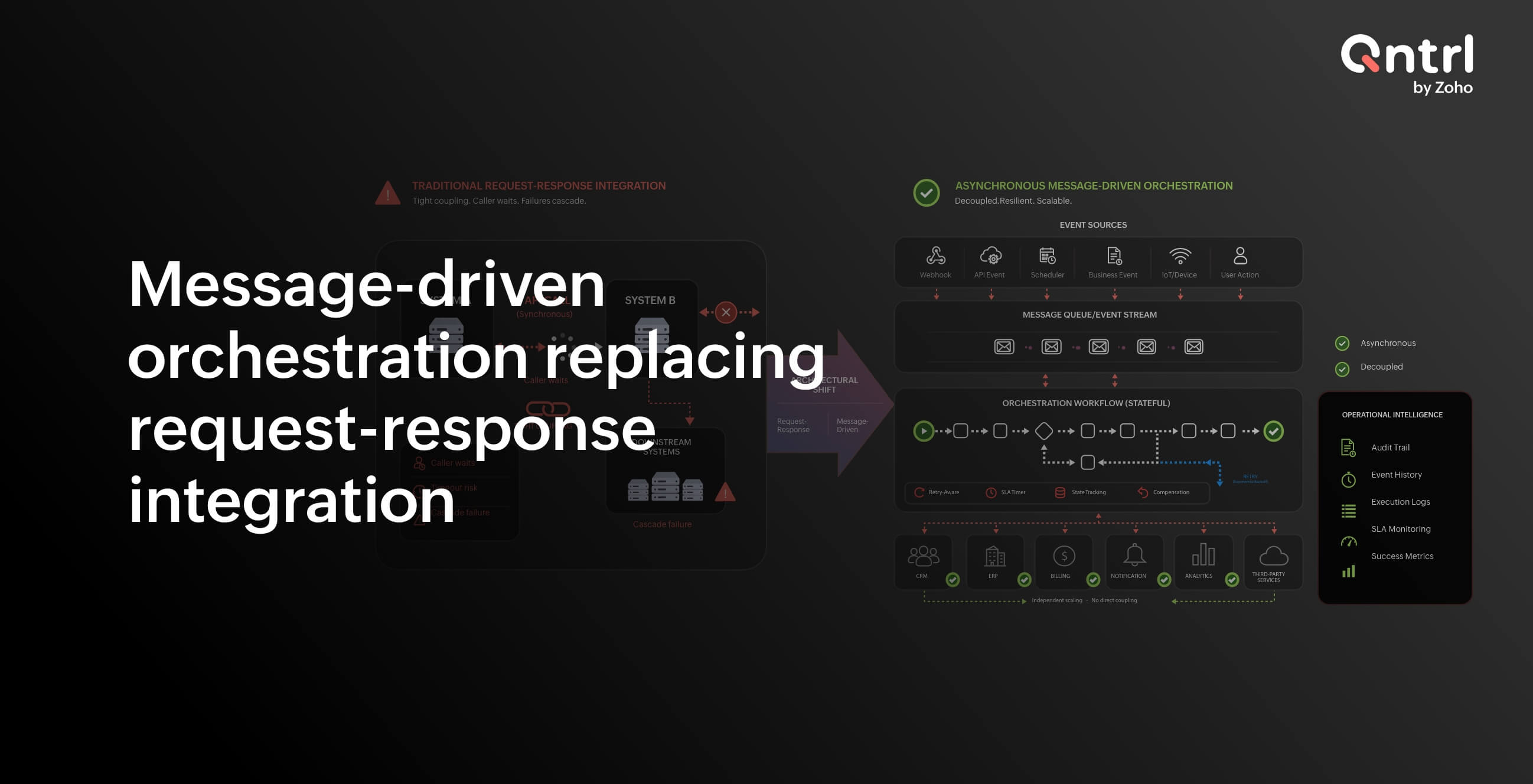
Traditional middleware was designed to solve a specific problem: allowing the exchange of data between different systems. Although this model is still useful in some scenarios, it has important limitations in complex enterprise environments.
Fragile integrations, scalability difficulties, excessive custom scripts, low traceability, and rules distributed across applications make operations less predictable and harder to govern.
In addition, traditional middleware usually ignores the operational context throughout the process. Data is transferred, but there's no layer responsible for controlling approvals, tracking status, validating policies, or coordinating decisions. Process-oriented middleware adds operational intelligence to integrations.
While traditional middleware is concerned with transporting information between applications, process-oriented middleware coordinates how work happens between systems, teams, and corporate rules. This means that the integration layer stops acting only as a data bridge and gains other functions:
Executing validations
Applying corporate policies
Controlling approvals
Triggering automations
Managing exceptions
Coordinating conditional workflows
Monitoring processes in real time
Ensuring end-to-end traceability
This approach transforms integration into a governed layer of operational execution. In practice, it means moving from point and reactive integrations to a structured, event-driven architecture prepared for critical enterprise operations.
Platforms like Qntrl incorporate business rules, approval workflows, event-based automations, and continuous monitoring, offering operational predictability, centralized governance, and the ability to adapt without requiring the replacement of existing systems.
The gains are clear:
Reduced complexity of point-to-point integrations
Less dependence on fragile scripts and isolated customizations
More agility to evolve processes without rewriting applications
Inclusion of legacy systems in modern and governed workflows
Greater operational visibility and traceability
Scalability for hybrid and distributed environments
Process-oriented middleware in practice
With process-oriented middleware, each step is executed at the right time and according to corporate policies. For large companies, the main features include:
Process orchestration: Defines the execution sequence needed to complete complex processes across multiple systems, teams, and business rules.
Event-driven automation: Allows events from ERPs, APIs, ITSM platforms, files, webhooks, or cloud applications to trigger workflows automatically in real time.
Application of business rules: Incorporates conditional decisions, corporate policies, approvals, validations, and operational criteria directly into the orchestration layer.
Governance and control: Centralizes operational policies, permissions, access rules, and execution controls in a governed environment.
Monitoring and visibility: Tracks processes end to end, identifies operational bottlenecks, monitors executions in real time, and facilitates audits and compliance.
In Qntrl, this logic is applied through resources that connect internal and external systems, execute automatic workflows based on events, and monitor each step from end to end.
Event-driven orchestration in hybrid environments
In modern architectures, corporate processes depend less and less on scheduled executions and more on real-time events.
Process-oriented middleware allows actions to be triggered automatically from events coming from ERPs, financial systems, ITSM platforms, APIs, files, webhooks, or cloud applications.
Instead of waiting for batch executions, workflows begin to respond dynamically to changes in the corporate environment.
In practice, this allows:
Automatic synchronization between cloud and on-premises systems
Real-time updates of tickets and incidents
Automatic approval of financial workflows
Controlled execution of server-side operations
Governance over APIs and internal services
Coordination of hybrid processes between different ERPs
Governance, traceability, and compliance
In critical enterprise operations, connectivity alone isn't enough. Traceability, compliance, and operational governance have become essential requirements for companies that operate in regulated and distributed environments.
Process-oriented middleware creates a centralized layer capable of recording decisions, tracking approvals, controlling permissions, and maintaining complete audit trails.
This allows IT, compliance, and operations teams to have clarity about:
Who executed each action
Which policies were applied
How data moved between systems
When exceptions occurred
How approvals were conducted
Which workflows were changed
In addition to strengthening regulatory compliance, this approach significantly improves operational predictability and reduces risks associated with decentralized integrations and manual processes.
Application examples
Qntrl acts as process-oriented middleware, capable of orchestrating workflows, applying business rules, and ensuring visibility and governance in real time.
See how the platform automates and organizes critical processes in different areas:
Human resources: When a new employee is registered, the middleware automatically triggers all steps of the onboarding process and provides status updates in control dashboards.
Compliance and governance: Audits, contract reviews, and corporate policies can be monitored automatically, with complete traceability of decisions, approvals, and exceptions.
IT and operations: Scheduled server updates can trigger automated scripts that restart services, run validations, notify of failures, and apply contingency actions without the need for manual intervention.
Financial operations: Invoice approval workflows can be automated between ERPs and financial systems, applying validations, compliance rules, and automatic data synchronization.
ITSM and corporate support: Incidents and tickets can be synchronized between ITSM platforms and internal systems, ensuring real-time updates, automatic escalation, and operational governance.
Governance of APIs and services: Internal services can be exposed in a controlled way, with validation, access control, request limits, and auditable monitoring.
Strategic benefits for complex enterprise environments
Platforms like Qntrl transform integration into a strategic layer of operational coordination. By centralizing workflows, automations, approvals, and business rules, organizations reduce risks, strengthen governance, and increase operational predictability.
Among the main benefits are:
Reduction of technical debt generated by point-to-point integrations
Greater scalability for hybrid and distributed environments
Less dependence on manual processes
More agility to adapt operational workflows
Better visibility over critical operations
Compliance with corporate policies and regulatory requirements
Simpler and more reliable audits
Decoupling between business rules and individual applications
In addition, centralizing operational logic makes it possible to evolve processes without needing to rewrite legacy systems or change critical architectures that are already consolidated.
When to adopt process-oriented middleware
In large organizations, some signs indicate the need to evolve the integration layer into process-oriented middleware:
Excessive dependence on manual interventions: Validations outside systems, constant monitoring by IT teams, and the need for frequent operational adjustments compromise scalability and predictability.
Scattered business rules: When corporate policies are spread across applications, scripts, and isolated integrations, any operational change becomes slower, more expensive, and subject to inconsistencies.
Difficulty scaling processes with governance: As new systems, areas, and business units become part of corporate workflows, it becomes harder to keep approvals, validations, and policies applied consistently.
Low operational visibility: Lack of end-to-end traceability compromises audits, compliance, SLA monitoring, and continuous improvement initiatives.
Fragile and hard-to-maintain integrations: Excessive dependence on custom scripts and point-to-point integrations increases operational risks and makes it harder to evolve enterprise architecture.
When these problems begin to affect operations, it becomes essential to adopt a process-oriented approach.
Qntrl acts as a central coordination layer capable of decoupling operational logic from individual applications, allowing IT to define, in a structured way, how processes should happen, which decisions are mandatory, and how each workflow will be monitored, audited, and governed.
By centralizing rules, automations, and decisions without replacing existing systems, process-oriented middleware reduces operational complexity and creates a more scalable foundation for the evolution of enterprise architecture.
This approach allows organizations to modernize operations gradually, integrate hybrid environments with governance, and respond more quickly to business changes without increasing technical debt or compromising operational predictability.
Learn how Qntrl can support this evolution in your company by requesting a free demo.
* Article written by journalist and developer Rafael Bruno

Enjoying your reading?
Enjoy organization and visibility too!
Qntrl can help you organise, control and improve production and projects in your team.