The enterprise integration playbook: Eliminate technical debt across legacy and modern systems
We can look across the spectrum of enterprises operating today, running on a patchwork of systems: SAP on-prem, Oracle databases, cloud CRMs, departmental tools, homegrown applications, and integration scripts that have been "temporary fixes" for years. As these environments grow, so does the complexity beneath them. Workflows slow down. Sync jobs fail silently. Data gets duplicated. Teams lose visibility. Over time, this becomes technical debt that impacts everything: speed, stability, security, and scalability.
This problem isn't new for CIOs and IT leaders. What is new is the scale and speed at which hybrid and legacy-heavy environments are becoming harder to manage. And every year, the cost of maintaining fragile integrations increases, while efficiency declines.
Qntrl bridging the gap
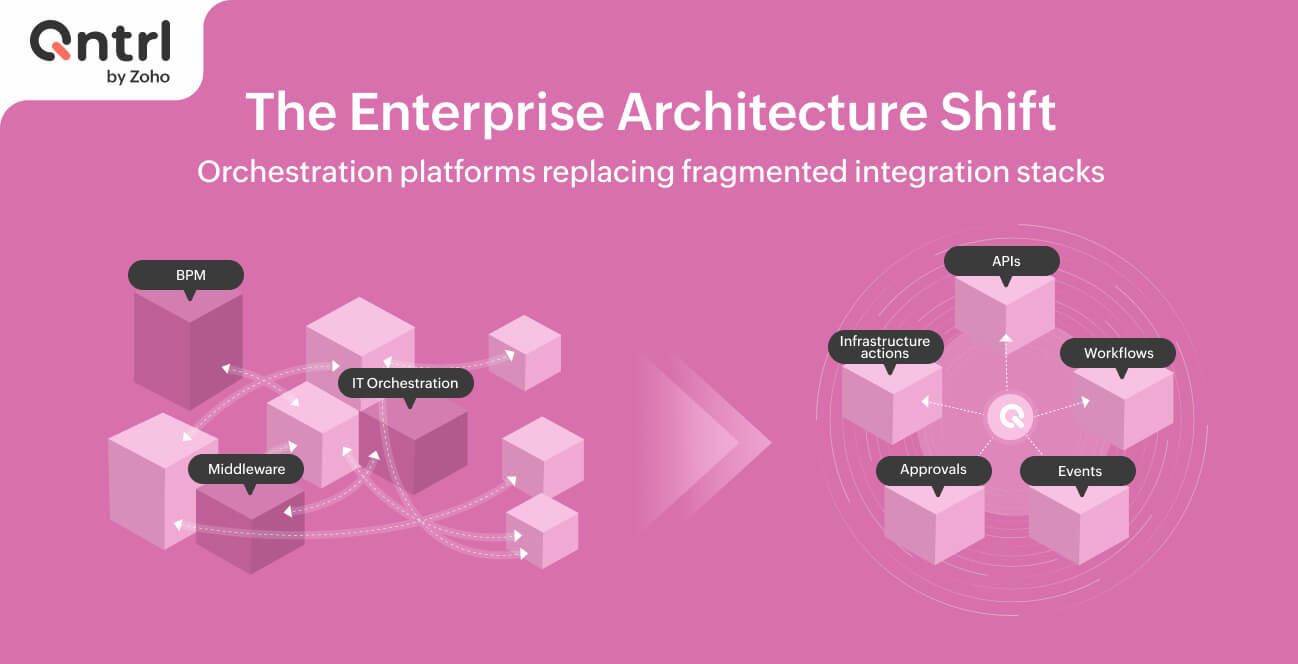
Qntrl solves this challenge by doing something traditional workflow tools do not: It acts as an orchestration engine and middleware layer that connects processes, systems, and data across your enterprise. Instead of stitching together tools with scripts and unstructured APIs, using tools that provide a structured way to automate, synchronize, and govern complex IT environments without replacing the systems you already rely on is a better bet.
Why technical debt grows in hybrid and legacy-heavy environments
Most enterprises operate a mix of on-premises platforms, cloud applications, and tools built over the years. While each system serves its purpose, they often speak different "languages." Some rely on SOAP, while others rely on REST. Some allow API access, others depend on file drops. Some sync instantly, others only update every few hours.
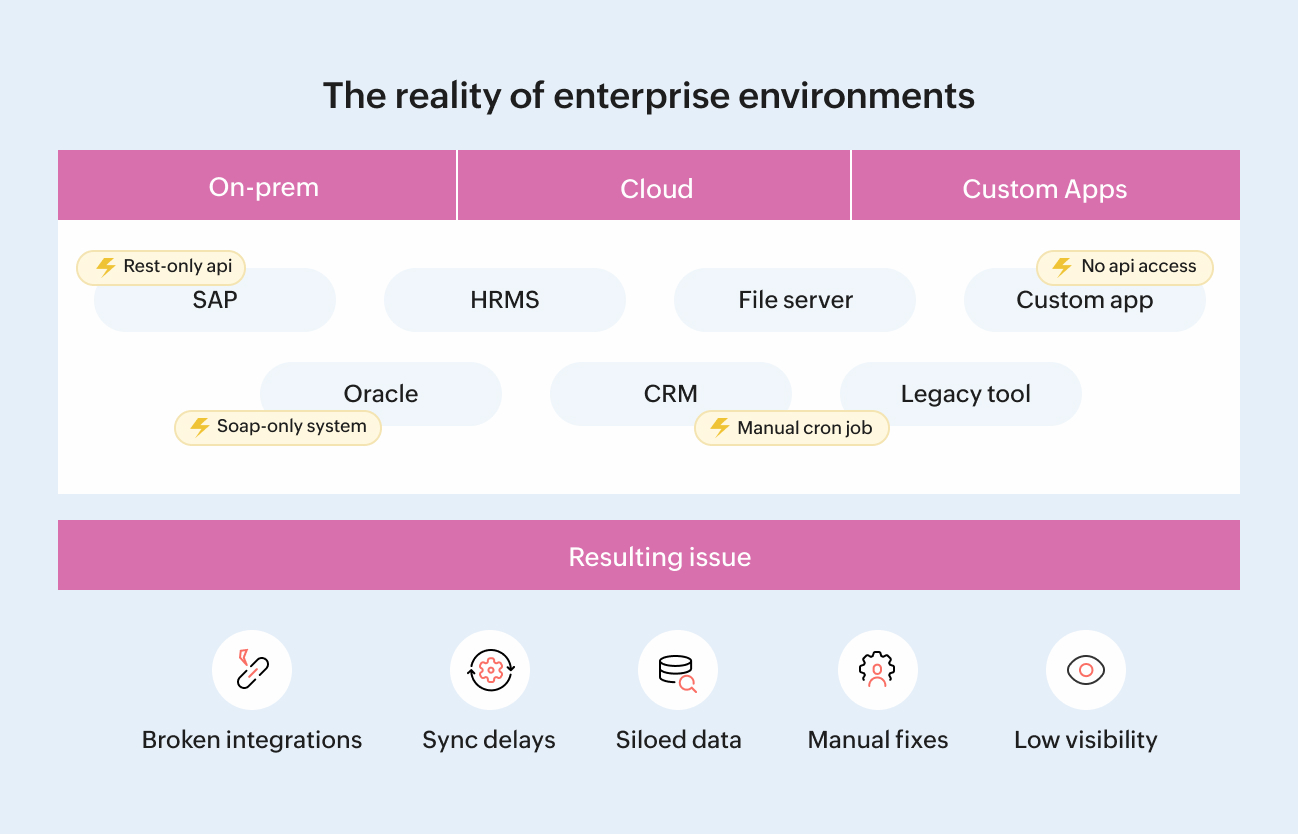
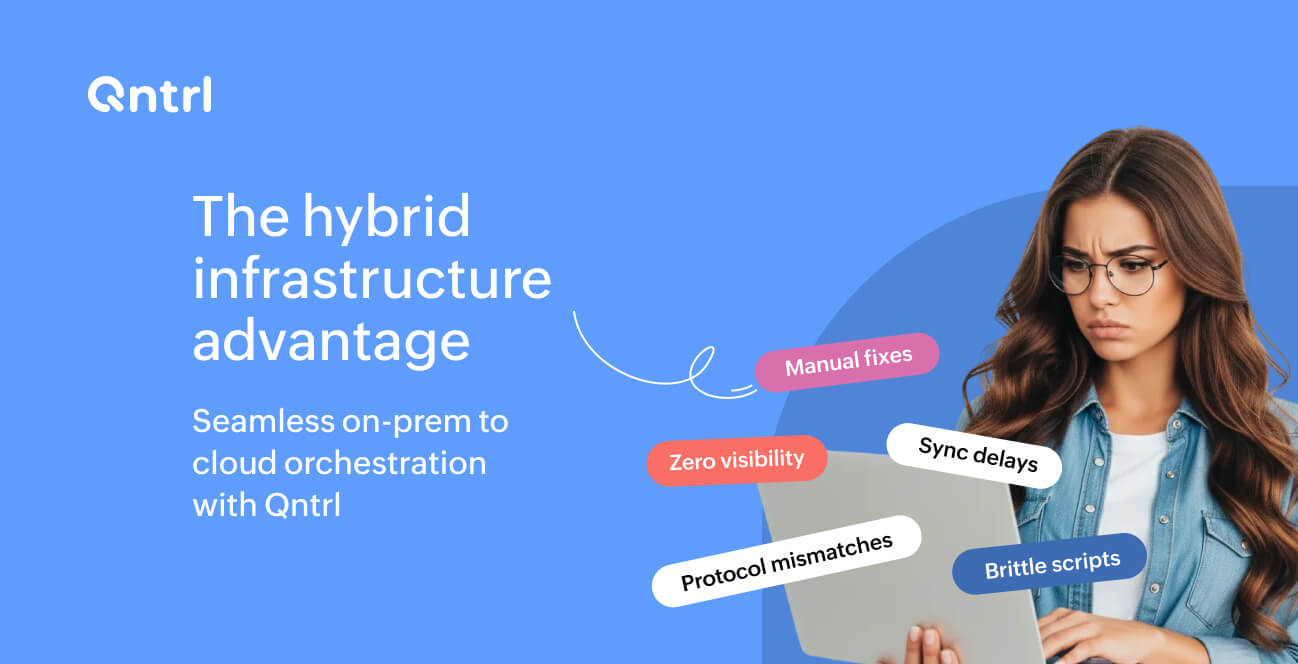
As organizations scale, several common issues appear:
- Brittle integrations that break easily
Systems rely on point-to-point scripts, manual jobs, cron-based schedulers, and data transformations that few people fully understand.
- Sync delays that affect operations
Teams experience multi-hour delays between system updates, which impact reporting, service delivery, and decision-making.
- Siloed APIs and incompatible protocols
Legacy systems often cannot communicate directly with modern cloud applications.
- Manual intervention in routine processes
IT teams become the "glue" that holds the system together, repairing sync failures, manually moving data, or coordinating between business teams.
- Lack of visibility and governance
No central place shows what is automated, what is failing, and what needs attention.
Over time, these pain points grow into operational risk. At this stage, CIOs are left with two choices: either rip-and-replace systems (an expensive option) or upgrade the orchestration layer so the ecosystem can work cohesively (a far more sustainable approach).
This is where Qntrl makes a measurable difference.
How Qntrl fixes enterprise integration challenges
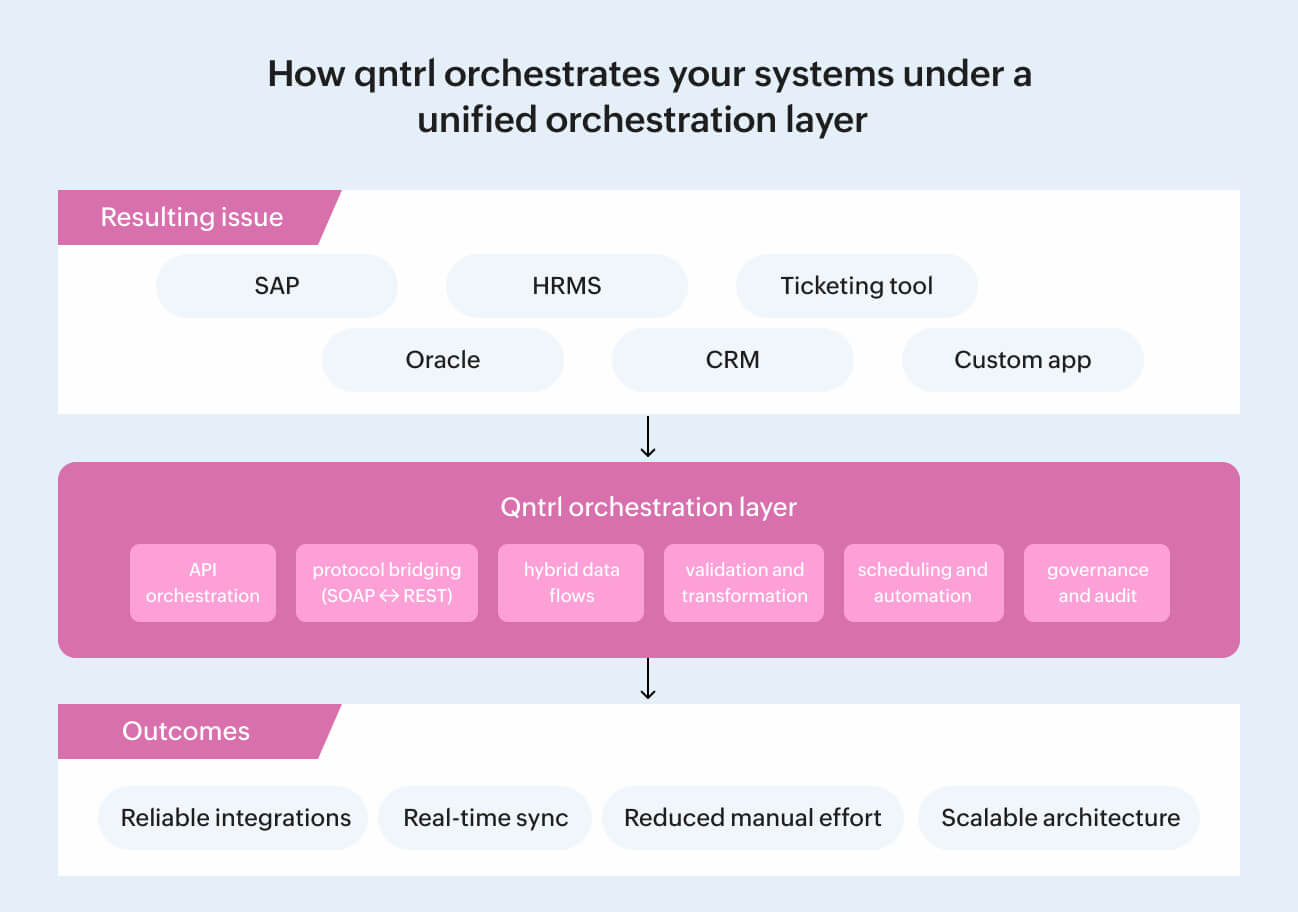
Qntrl eliminates technical debt by introducing a structured orchestration engine across your business and IT systems. Instead of ad-hoc scripts or fragmented automation, Qntrl provides a unified layer for:
1. API orchestration across systems
Qntrl can orchestrate data flows across REST, SOAP, and custom APIs, enabling legacy and modern systems to exchange information reliably.
Examples include:
- Connecting SAP ECC with cloud CRMs
- Syncing HRMS platforms with IT service desks
- Bridging custom on-prem applications with cloud tools
Every trigger, transformation, and action is governed in a single place, making the system predictable rather than fragile.
2. Protocol handling for legacy systems
Many enterprises struggle with mismatches between SOAP and REST. Qntrl abstracts this away by allowing teams to move data between incompatible systems without requiring custom code.
This reduces the need for standalone middleware, patchwork transformations, or specialized resources.
3. Hybrid and on-premise data flows
Enterprises rarely run fully cloud-based environments. Qntrl enables secure hybrid transmission by coordinating data across:
- On-prem data centers
- Private cloud
- Public cloud
- Distributed teams
This is essential for companies undergoing digital transformation but still dependent on critical legacy systems.
4. A configurable middleware layer
Qntrl acts as a low-code middleware platform that:
- Processes data
- Validates inputs
- Structures workflow paths
- Connects API endpoints
- Schedules synchronization jobs
- Automates system-level tasks
This removes the dependency on custom scripts and strengthens long-term maintainability.
How middleware, circuits, and governance work together in Qntrl
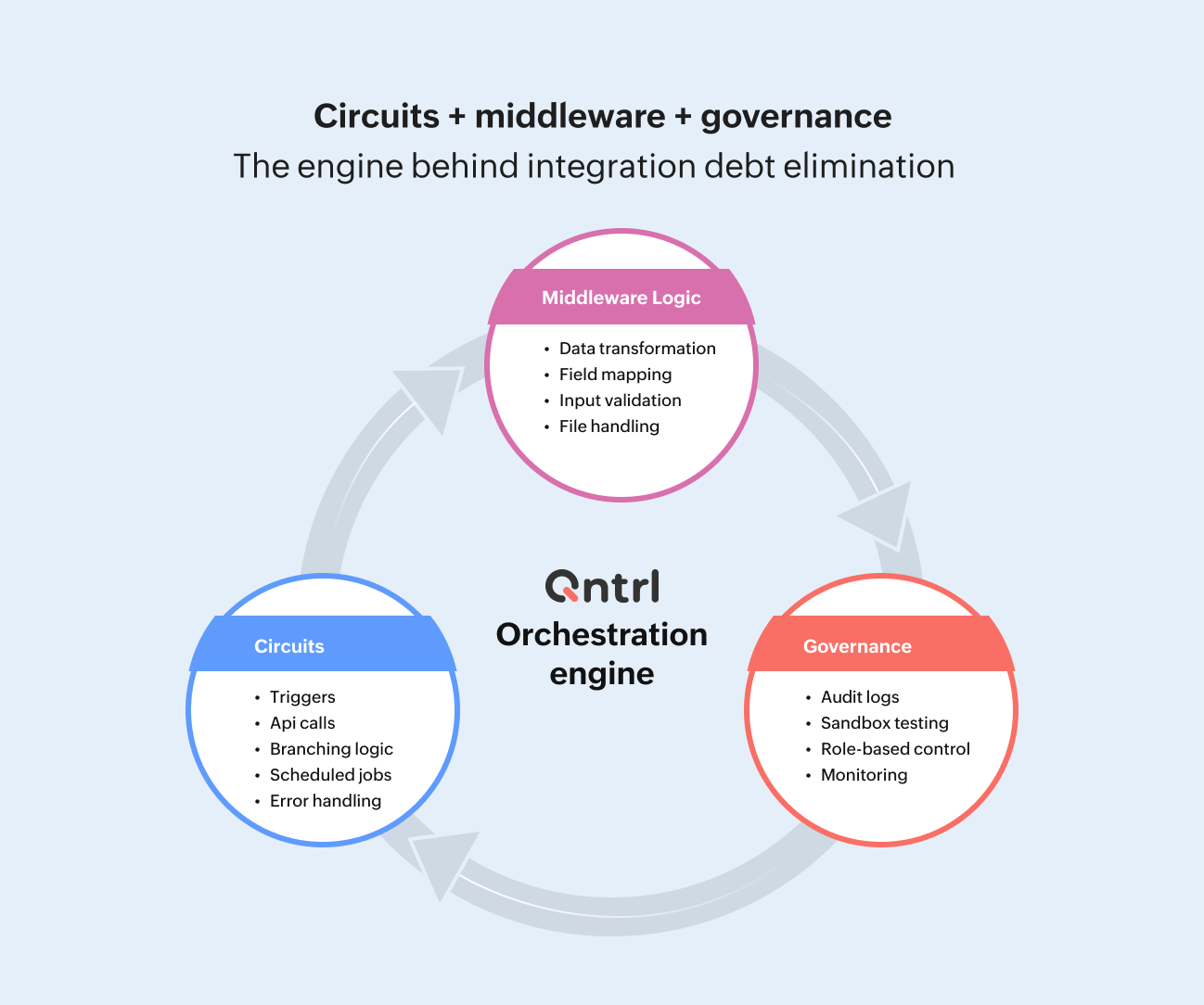
To eliminate integration debt, enterprises need more than automation. They need structure, visibility, and a single point of governance to oversee how systems communicate: in other words, orchestration of processes and systems. Qntrl delivers this through three connected layers:
1. Middleware logic, handling the "translation" between systems
Qntrl manages:
- Data transformations
- Field mappings
- Validation rules
- File exchanges (where APIs don't exist)
This makes it easy to link systems without modifying them.
2. Circuits, orchestrating system-to-system flows
Circuits are where the orchestration happens.
They define:
- Triggers
- API calls
- Branching logic
- Scheduled jobs
- Error handling
- Event-based automation
Circuits enable IT teams to visually construct complex integration flows that would otherwise require multiple scripts and maintenance-intensive tools.
3. Enterprise governance, ensuring reliability and compliance
Qntrl includes:
- Audit logs
- Access controls
- Version history
- Sandbox testing
- Failure alerts
- Monitoring
This gives CIOs full visibility into every workflow and integration path. Changes can be tested safely before deployment, reducing operational risk.
Together, these layers form a modern orchestration engine designed for hybrid enterprises.
What enterprises gain by using Qntrl
Organizations that adopt Qntrl typically see the following outcomes:
1. Reduced operational failures
Broken syncs, outdated scripts, and integration failures drop dramatically because Qntrl centralizes all logic.
2. Higher uptime and reliability
Automated retries, monitored jobs, and structured orchestration keep systems aligned without manual intervention.
3. Lower maintenance and IT burden
IT teams no longer spend time fixing job failures or modifying brittle scripts.
They focus on strategy rather than patchwork tasks.
4. Scalable architecture as the business grows
New systems, integrations, and processes can be added to Qntrl as the organization expands.
5. Governance across every integration path
CIOs get the visibility required to meet enterprise compliance and operational standards.
6. No need to "rip and replace" existing systems
Qntrl works with the tools enterprises already use, including cloud, on-prem, legacy, and hybrid.
A better way to orchestrate your ecosystem
Technical debt is inevitable in hybrid IT environments, but it doesn't have to hinder your enterprise's progress. Qntrl offers a sustainable approach to eliminating integration fragility, reducing manual effort, unifying systems, and establishing a scalable process architecture that supports long-term growth and sustainability.
Instead of stitching together various tools, Qntrl provides your organization with a single orchestration layer, one that centralizes automation, enhances reliability, and gives IT leaders the control they've been missing.
Ready to clean up your integration landscape?
See how Qntrl can unify your systems and eliminate technical debt.
Book a demo → https://www.qntrl.com/request-demo.html

Enjoying your reading?
Enjoy organization and visibility too!
Qntrl can help you organise, control and improve production and projects in your team.