The hybrid infrastructure advantage: Seamless on-prem-to-cloud orchestration
Enterprises evolve in different ways, and rarely run on a single model, shaped uniquely by their teams and workflows. As a result, most organizations operate in a hybrid environment that spans on-prem systems, cloud applications, and legacy technology.
The mix may be intentional or simply the result of years of growth, acquisitions, and system changes, but the outcome is always the same, dozens of tools built years apart, running on different protocols, speaking different “languages,” and relying on integrations that rarely survive at scale.
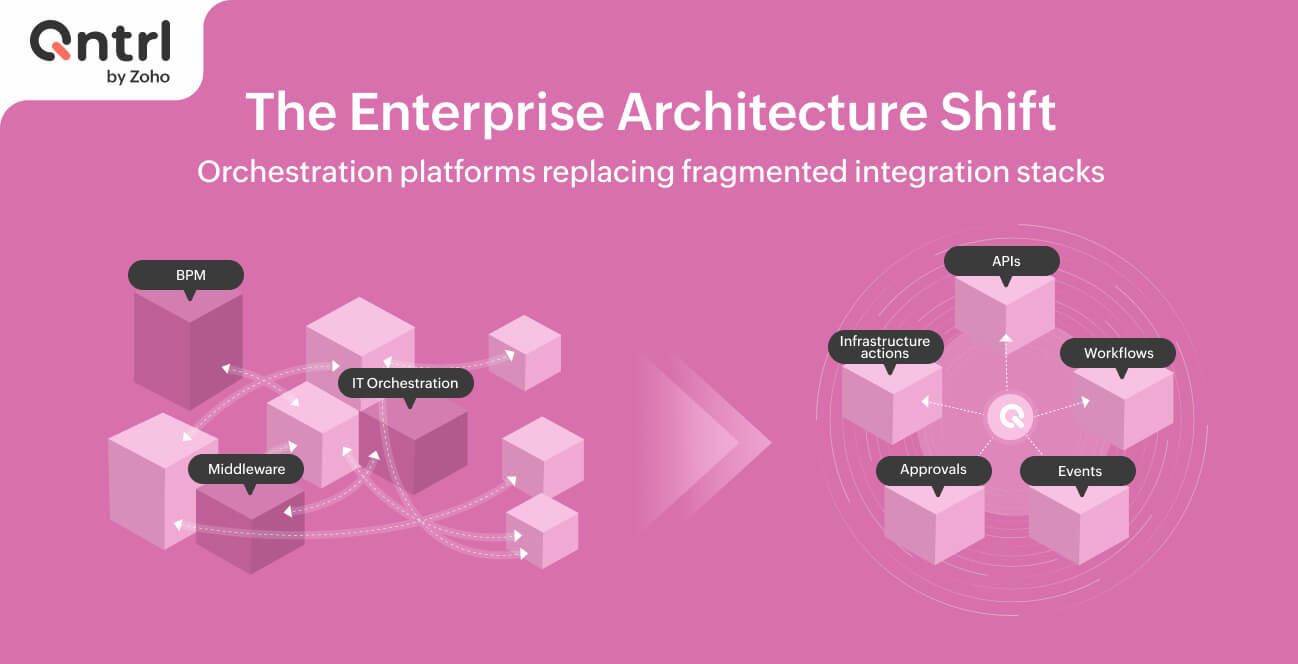
This complexity is the reason hybrid ecosystems are prone to decentralized operational outcomes that become hard to keep track off very quickly. It’s also why enterprises evaluate orchestration platforms like Qntrl to bring control, consistency, and visibility back into their infrastructure.
Why hybrid ecosystems break easily
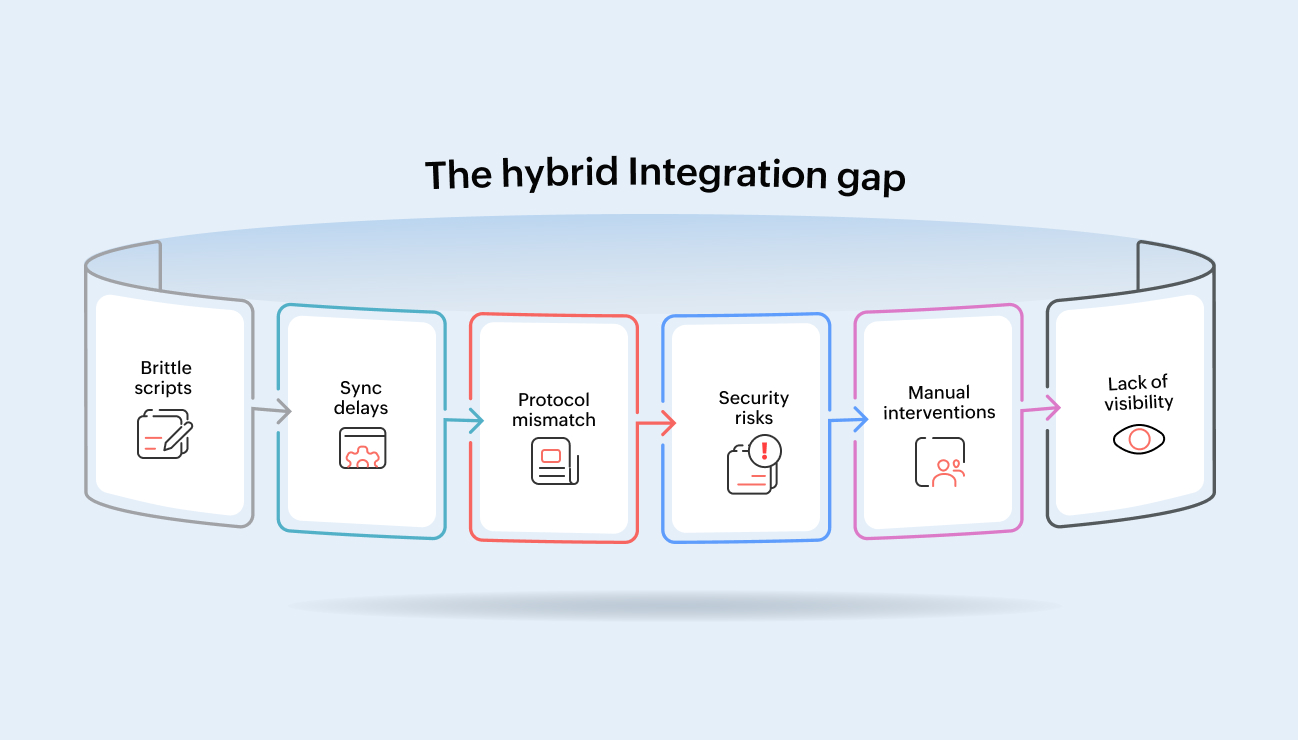
Most hybrid environments evolve naturally, not through planned architecture. Over time, the mix of systems introduces gaps that make operations slow, inconsistent, or risky. Common issues include:
Manual jobs and fragile scripts
Teams rely heavily on one-off scripts, cron jobs, custom connectors, or shared folders to move data between systems. When the people who wrote these scripts leave, much of the logic disappears with them.
Sync delays that disrupt operations
Systems update at different intervals, some instantly, others hourly or weekly. This inconsistency affects reporting, customer experience, and decision-making.
Security risks during data transmission
On-prem applications, private cloud systems, and SaaS platforms often have different authentication models. Without a unified governance layer, IT teams must manually manage tokens, credentials, and API security.
Protocol mismatches between old and new systems
Legacy systems still rely on SOAP or proprietary formats, but modern SaaS tools run REST APIs. When these systems can't communicate with each other, IT teams become the “bridge,” manually transforming data formats.
Brittle integrations that fail quietly
Most enterprises lack a central view of what's automated, what depends on scripts, and what has already failed. Teams only discover issues when someone complains.
These challenges compound over time, leading to what CIOs refer to as “integration debt,” an expensive, risky, and resource-intensive endeavor to maintain. Instead of ripping out and replacing core systems, enterprises need an orchestration layer that reliably connects their hybrid environments.
How Qntrl solves the hybrid integration challenge
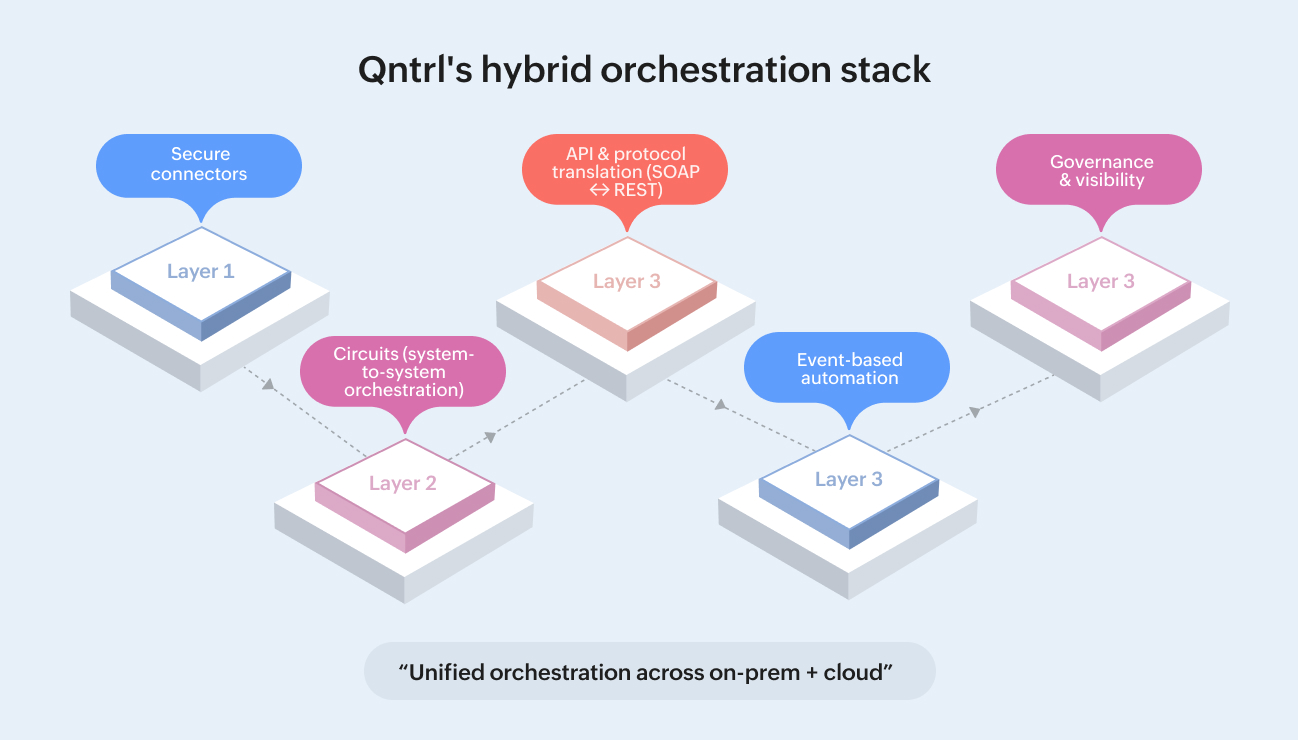
Qntrl is built as an orchestration engine that unifies on-prem systems, cloud applications, and internal tools through a structured layer of governance, automation, and integration control. Its capabilities allow IT teams to replace point-to-point scripts with a sustainable architecture built for long-term growth.
Secure hybrid connectors for on-prem-to-cloud data flows
Qntrl supports secure communication across:
- On-prem data centers
- Private cloud
- Public cloud
- Distributed SaaS applications
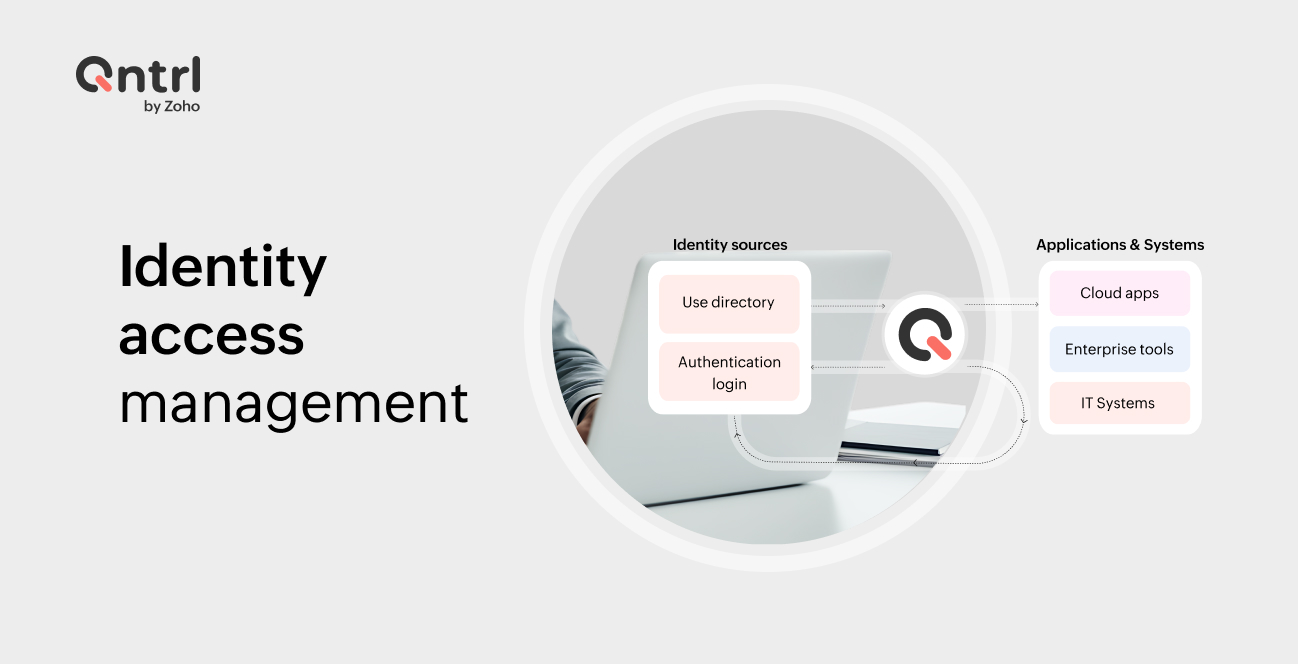
Qntrl’s orchestration layer ensures safe data movement with role-based access controls, encrypted communication, and centralized admin management. This allows teams to manage hybrid flows without manually handling credentials or building risky custom scripts.
Circuits for system-to-system orchestration
Circuits in Qntrl provide a visual, low-code space for building complex system-to-system integrations without writing heavy scripts.
Circuits can:
- Trigger workflows based on events
- Call REST or SOAP APIs
- Schedule synchronization jobs
- Branch logic based on conditions
- Manage errors and retries
- Update multiple systems at once
Instead of building integrations individually, circuits enable IT teams to design the entire workflow visually, from trigger to transformation to action, centralizing logic that was previously scattered.
API transformation and protocol handling (SOAP ↔ REST)
Hybrid setups often fail because the old and new systems cannot communicate directly with each other.
Qntrl eliminates this barrier by:
- Converting SOAP responses into REST-compatible formats
- Handling XML and JSON transformations
- Mapping fields between legacy and modern systems
- Cleaning or validating inputs before sending them downstream
This effectively allows systems that are built a decade apart to communicate as if they were native to each other.
Event-based automation for real-time updates
Instead of relying on scheduled jobs, Qntrl can trigger workflows automatically based on events inside systems. For example:
- A user creation in HRMS triggers provisioning tasks
- A ticket update in the service desk triggering system sync
- A purchase order approval triggering ERP updates
Event-driven orchestration helps enterprises eliminate delays, reduce manual intervention, and maintain consistent system behavior.
Hybrid use cases powered by Qntrl
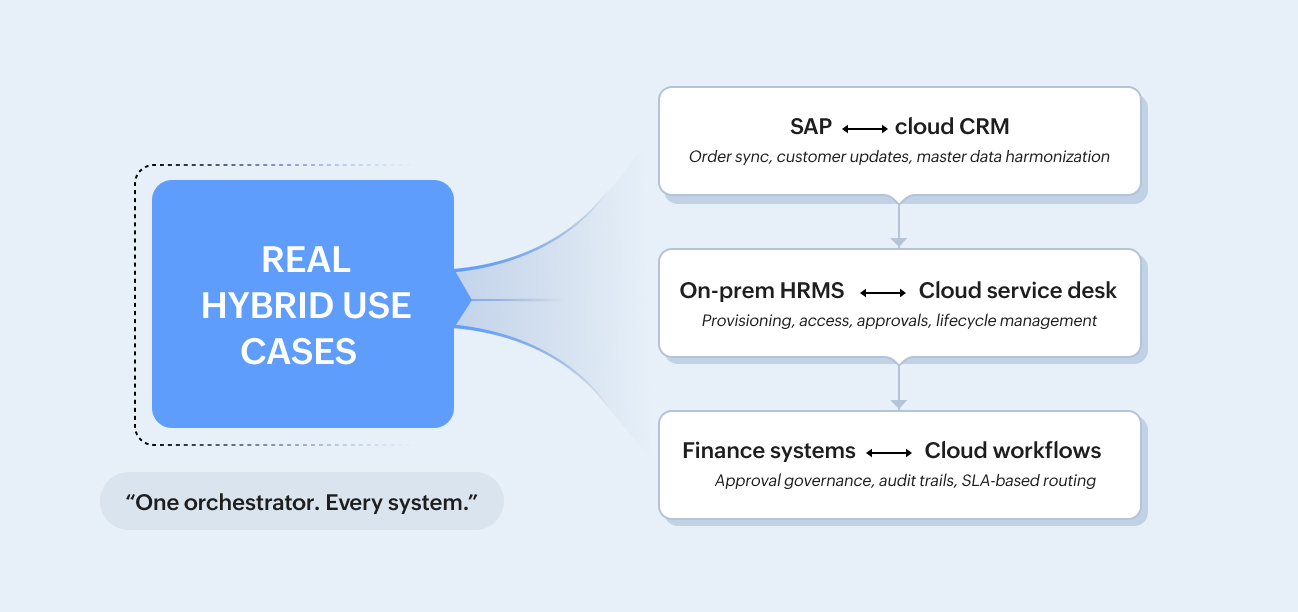
SAP ECC ↔ cloud CRM orchestration
Most enterprises run SAP as their core recordkeeping system, while managing frontline operations through cloud-based CRMs.
Qntrl orchestrates:
- Customer data sync
- Order status updates
- Invoice synchronization
- Master data harmonization
- Change notifications between systems
By managing the mapping and orchestration centrally, Qntrl ensures consistent, real-time updates without relying on multiple custom connectors.
On-prem HRMS ↔ cloud service desk
User provisioning is one of the most common hybrid workflows.
Qntrl automates:
- New user creation
- Asset requests
- Access provisioning
- Account deactivation
- Manager approvals
- IT fulfillment
Data moves securely between the HRMS, identity systems, and service desks through circuits. This eliminates the need for spreadsheets, email-based processes, and manual approvals that are prone to risk.
Finance approvals across mixed systems
Enterprises often run finance systems on-prem (SAP, Oracle, Epicor), while approval workflows occur in cloud tools or homegrown apps.
With Qntrl:
- Approval workflows run in boards and blueprints
- Circuits push approved data into finance systems
- Audit logs capture every approval action
- SLAs ensure timely movement
- Governance ensures compliance
This creates a reliable bridge between departments and systems, improving transparency and reducing audit risk.
Outcome: Real-time orchestration with fewer failures and lower maintenance
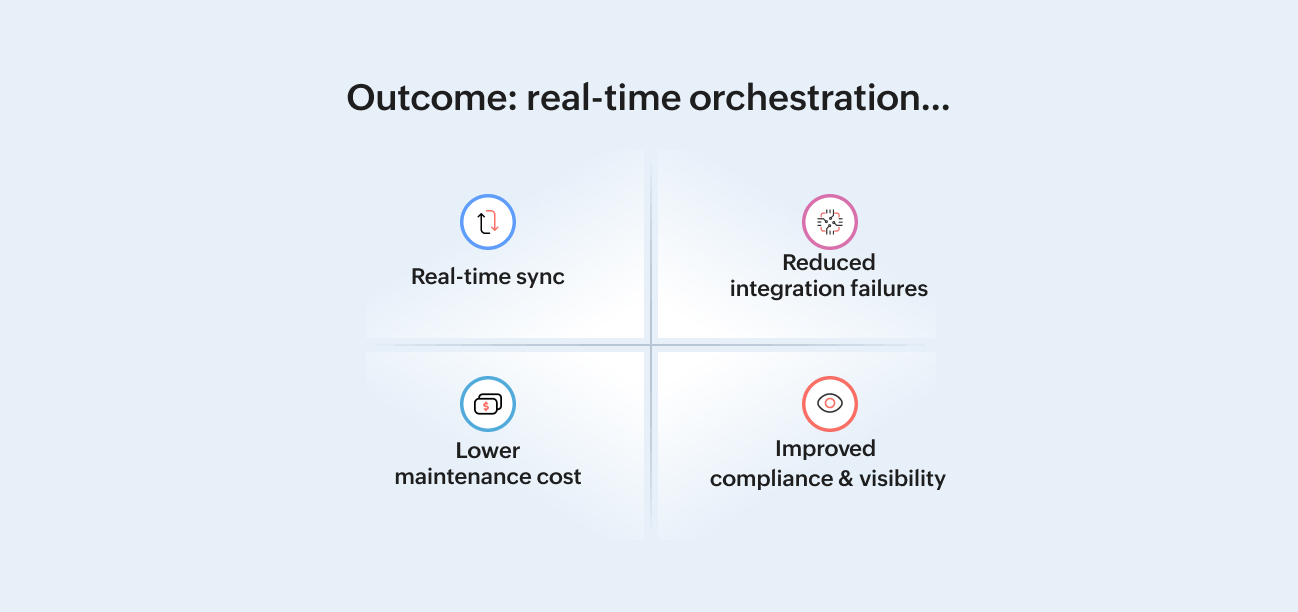
Enterprises using Qntrl for hybrid orchestration see measurable improvements across their IT operations.
Faster, real-time updates
Event-driven circuits eliminate delays and maintain system synchronization.
Reduced integration failures
Centralized orchestration replaces brittle scripts and undocumented logic.
Lower maintenance costs
Teams no longer rewrite connectors for every new system; Qntrl standardizes how integrations are built and governed.
Greater security and compliance
Audit logs, role-based access controls, and sandbox testing ensure safe and traceable deployments.
Better scalability
Because logic lives in Qntrl, not in scripts, enterprises can extend workflows across teams and systems without rework.
Why unifying orchestration layers like Qntrl serve you better
Hybrid ecosystems are here to stay. Replacing systems is expensive, risky, and unrealistic for most enterprises. The smarter way forward is strengthening the orchestration layer that connects them.
Qntrl provides exactly that: Secure hybrid connectors, low-code circuits, event-driven automation, protocol transformation, and full governance. Together, these capabilities allow enterprises to eliminate integration debt, reduce operational failures, and achieve true hybrid harmony between on-prem and cloud environments.
See Qntrl in action for hybrid environments

Enjoying your reading?
Enjoy organization and visibility too!
Qntrl can help you organise, control and improve production and projects in your team.